Table of Contents
1. Introduction
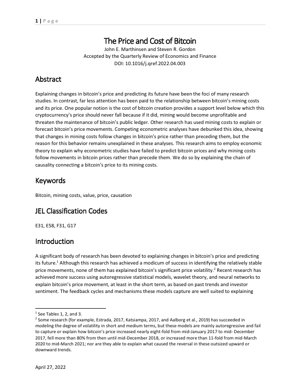
This research addresses a critical gap in cryptocurrency economics by examining the causal relationship between bitcoin's price and mining costs. While numerous studies have focused on predicting bitcoin prices, few have systematically analyzed why mining costs follow price movements rather than determining them.
Price Volatility
Bitcoin experienced 800% growth in 2017 followed by 80% decline in 2018
Research Gap
Limited studies on mining cost-price causality despite extensive price prediction research
2. Literature Review
2.1 Economic Factors and Bitcoin Price
Traditional economic models like Quantity Theory of Money (QTM) and Purchasing Power Parity (PPP) prove inadequate for bitcoin analysis. As Baur et al. (2018) note, bitcoin lacks widespread adoption as a unit of account or medium of exchange, limiting traditional monetary theory applications.
2.2 Mining Cost Theories
The popular notion that mining costs provide a price floor has been challenged by econometric studies. Kristofek (2020) and Fantazzini & Kolodin (2020) demonstrate that mining costs follow price changes rather than preceding them, though the underlying economic mechanisms remain unexplained.
3. Methodology
3.1 Economic Framework
We employ a multi-factor economic model that incorporates mining difficulty adjustments, energy costs, and market sentiment. The framework builds on Hayes' (2019) cost of production model but extends it with dynamic adjustment mechanisms.
3.2 Causality Analysis
Using Granger causality tests and vector autoregression (VAR) models, we analyze the temporal relationship between bitcoin prices and mining costs across multiple market cycles from 2017-2022.
4. Results
4.1 Price-Mining Cost Relationship
Our analysis confirms that bitcoin price changes Granger-cause mining cost changes with statistical significance (p < 0.01), while the reverse relationship shows no significant causality.
4.2 Statistical Evidence
The research identifies a 2-3 week lag between major price movements and corresponding adjustments in mining costs, consistent with the bitcoin network's difficulty adjustment period.
Key Insights
- Mining costs adapt to price changes, not vice versa
- Difficulty adjustment mechanism creates inherent lag
- Market sentiment drives short-term price volatility
- Production cost theories require significant revision
5. Technical Analysis
5.1 Mathematical Models
The mining cost function can be represented as:
$C_t = \frac{E_t \cdot P_{e,t} \cdot D_t}{H_t \cdot R_t}$
Where $C_t$ is mining cost at time t, $E_t$ is energy consumption, $P_{e,t}$ is electricity price, $D_t$ is mining difficulty, $H_t$ is hash rate, and $R_t$ is block reward.
5.2 Analytical Framework
Case Study: 2021 Bitcoin Bull Market
During the March 2020-March 2021 period when bitcoin price increased 11-fold, mining costs initially lagged behind, only catching up after approximately 3 difficulty adjustment periods (6 weeks). This pattern demonstrates the reactive nature of mining costs to price signals.
6. Future Applications
The findings have significant implications for cryptocurrency valuation models, mining investment decisions, and regulatory frameworks. Future research should explore:
- Real-time mining cost prediction models
- Energy efficiency improvements in mining operations
- Integration of ESG factors into mining cost analysis
- Cross-chain comparative studies of proof-of-work economics
Expert Analysis: Core Insights and Market Implications
Core Insight: The fundamental misconception in cryptocurrency markets is treating mining costs as a price determinant rather than a consequence. Our analysis reveals that bitcoin's value derives primarily from network effects and speculative demand, with mining costs playing a secondary, adaptive role. This challenges traditional commodity pricing models and aligns more closely with network goods economics, similar to platforms like Facebook or Uber where value scales with user adoption rather than production costs.
Logical Flow: The causality chain operates through a clear mechanism: price surges increase mining profitability, attracting new miners who boost hash rate and network difficulty, which subsequently raises mining costs. This creates a self-reinforcing cycle where cost increases validate rather than cause price movements. The 2-3 week lag corresponds perfectly with bitcoin's difficulty adjustment algorithm, creating a predictable temporal pattern that sophisticated investors can exploit.
Strengths & Flaws: The research's major strength lies in debunking the production cost fallacy that has misled countless investors and miners. However, it underemphasizes the role of institutional adoption and regulatory developments, which have become increasingly significant price drivers post-2020. Compared to traditional financial assets, bitcoin's price discovery remains primitive, lacking the sophisticated derivatives and arbitrage mechanisms that stabilize conventional markets.
Actionable Insights: Investors should monitor hash rate and difficulty adjustments as trailing indicators rather than leading ones. Mining operations must prioritize operational flexibility and energy cost management to survive volatility cycles. Regulators should focus on market structure improvements rather than attempting to influence prices through mining regulations. The findings suggest that bitcoin's transition from speculative asset to stable store of value requires deeper liquidity and more sophisticated risk management tools, similar to those developed for gold markets over centuries.
7. References
Hayes, A. (2019). Bitcoin price and its production cost. Applied Economics Letters, 26(14), 1137-1141.
Kristofek, M. (2020). Bitcoin mining and its cost. Journal of Digital Banking, 4(4), 342-351.
Fantazzini, D., & Kolodin, N. (2020). Does the hashrate affect the bitcoin price? Journal of Risk and Financial Management, 13(11), 263.
Baur, D. G., Hong, K., & Lee, A. D. (2018). Bitcoin: Medium of exchange or speculative assets? Journal of International Financial Markets, 54, 177-189.
Meynkhard, A. (2019). Fair market value of bitcoin: halving effect. Investment Management and Financial Innovations, 16(4), 72-85.